Government of India
 More
More

Our Blogs

From Curiosity to Competency: PARAKH at the Preparatory Stage
-
2026-06-19 12:00:00
-
Parakh NCERT
- By Indrani Bhaduri
India has made significant progress in reforming its education system. These reforms aim to make education more relevant, resilient and inclusive to 21st-century challenges. The National Education Policy 2020 introduced the 5+3+3+4 curricular structure. This structure is aligned with the developmental needs of learners at different stages of schooling. It recognises that children require age-appropriate learning experiences, pedagogical approaches and assessment practices. As per NEP 2020, the Preparatory Stage consists of three years of schooling, from Classes III to V. It builds on the play-based, discovery-based and activity-based learning of the Foundational Stage. At the same time, it gradually introduces textbooks, written work, formal classroom routines, structured academic engagement, and more systematic learning across curricular areas. This stage acts as a bridge between early childhood learning and the more specialised subject-based learning of the Middle Stage. The policy also marks a decisive shift from rote memorisation to competency-based education. Assessment at this stage is no longer seen only as a tool for ranking students or awarding certification. It is now understood as a process that supports learning.
To support this transformation, Paragraph 4.41 of NEP 2020 proposed the establishment of PARAKH, Performance Assessment, Review and Analysis of Knowledge for Holistic Development, as India’s National Assessment Centre. PARAKH plays a key role in strengthening assessment reform in India. It develops norms, standards and guidelines for student assessment. It also conducts large-scale surveys and promotes assessment practices that are aligned with 21st-century learning goals.
The Preparatory Stage lays the foundation for reading, writing, speaking, mathematics, science, social understanding, art, physical education, and well-being. Learners at this stage are active, imaginative, and hands-on. Therefore, learning must include concrete materials, local examples, field experiences, stories, games, art, movement, and conversation. The key curricular areas include two languages, Mathematics, Art Education, Physical Education and Well-being, and The World Around Us. The World Around Us is interdisciplinary and connects children with their natural, social, and human environments. It also includes work and pre-vocational skills such as stitching, cooking, craft, gardening, and model-making. The NCF-SE sets competency-based learning standards for these areas. PARAKH’s Holistic Progress Card gives these standards a practical classroom assessment structure. It helps teachers observe what learners know, understand, express, perform, and apply by the end of the stage.
The Holistic Progress Card developed by PARAKH-NCERT for the Preparatory Stage is a practical response to the vision of NEP 2020 and NCF-SE. It provides a comprehensive and descriptive system for reporting learners’ progress in relation to domains, curricular goals, competencies, and learning standards. It recognises that learning is multidimensional. Therefore, it does not focus only on academic achievement. It also gives importance to physical, emotional, social, ethical, creative, intellectual, and behavioural development.
The HPC at the Preparatory Stage focuses on strengthening the socio-emotional aspects of learning while gradually introducing structured academics. Learners engage in collaborative projects, art-integrated tasks, community-based experiences, hands-on work, reflective exercises, self-assessment, peer assessment, parent observation and portfolio-based documentation. These practices nurture empathy, confidence, cooperation, curiosity, responsibility, and ownership of learning. The HPC empowers learners to take an active role in their educational journey. It creates opportunities for learners to reflect on their strengths, weaknesses, learning needs, and progress. It also gives parents a meaningful role in observing and supporting the child’s development. In this way, the HPC creates 360-degree view of learning through the participation of teachers, students, peers, and parents.
The assessment structure at the Preparatory Stage is centred on formative assessments conducted throughout the year. These assessments are mapped to competencies from the NCF-SE. They provide continuous feedback and reduce the burden of one-time examinations. Assessment is balanced with 70% formative and 30% summative evaluation. This balance keeps classroom observation, projects, portfolios, self-assessment, peer assessment, parent observation, oral responses, written tasks, and activity-based evidence at the centre. At the same time, it gradually prepares learners for short written assessments and readiness-based evaluation.
Formative assessments are conducted in two formats. The first is pre-announced formative assessment. These assessments are conducted for accountability purposes. A date sheet and syllabus are shared with students in advance. The second is ongoing formative assessment. These assessments take place alongside regular teaching-learning activities and act as a feedback loop for teachers and learners. Short formal written assessments are appropriate at this stage. However, they must not dominate the assessment process. Teachers’ observation of students’ work should continue to remain an important assessment mechanism. Periodic summative assessments may be used to supplement regular formative assessments. At the end of each year of the Preparatory Stage, a comprehensive summative assessment may be conducted. This can help understand the learner’s readiness to enter the next grade. Additional support may also be provided during the break, wherever required.
Parent observation is a major component of the Holistic Progress Card. It makes parents an integral part of the child’s learning journey. Parent observations are taken once in every term, that is, twice during the academic year. Through a set of questions, parents share observations, feedback, and reflections on their child’s progress. Teachers compare parent feedback with their own classroom observations to identify similarities and differences in the child’s development at home and in school. This strengthens collaboration between parents, educators, and learners.
Self-assessment refers to the process through which students evaluate their own work or performance. They reflect on their learning, strengths, weaknesses, and areas for improvement. Peer assessment refers to the process through which students evaluate each other’s work. This is done based on set criteria. It may involve feedback, grading, or both. Self-assessment and peer assessment are part of the observation tools in the Holistic Progress Card. They help teachers understand how learners assess their own competencies. They also show whether peers observe similar progress. Self-assessment and peer assessment are included in every term. They are conducted twice during the academic year, in FAC 2 and FAC 4. This is done through a set of questions in the HPC. These processes encourage students to engage more deeply with teaching and learning. Evaluating their own work sharpens analytical and evaluative skills. Evaluating the work of others also builds reflection and judgment. Learners become more accountable for their performance. They also become more aware of their learning journey. The student portfolio is a significant component of the Holistic Progress Card. It is a collection of the student’s work that shows learning progress, achievements, skills, and reflections over time. Every child maintains a portfolio to record work and track development. A designated folder is provided as part of the stationery and book set for systematic maintenance of the student portfolio.
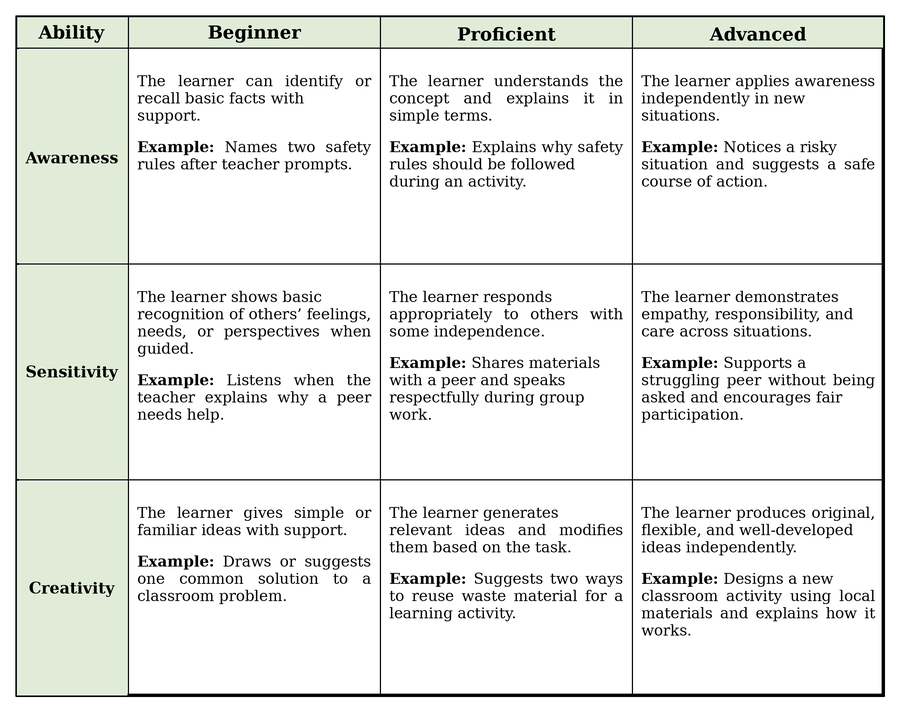
The PARAKH taxonomy helps organise assessment beyond recall-based questions. It supports the evaluation of deeper abilities among learners. For the Preparatory Stage, learner progress is understood through three broad abilities: Awareness, Sensitivity, and Creativity. It is organised around the three abilities of Awareness, Sensitivity, and Creativity. Each ability may be observed through three performance levels: Beginner, Proficient, and Advanced. These levels make the rubric developmental rather than judgemental.
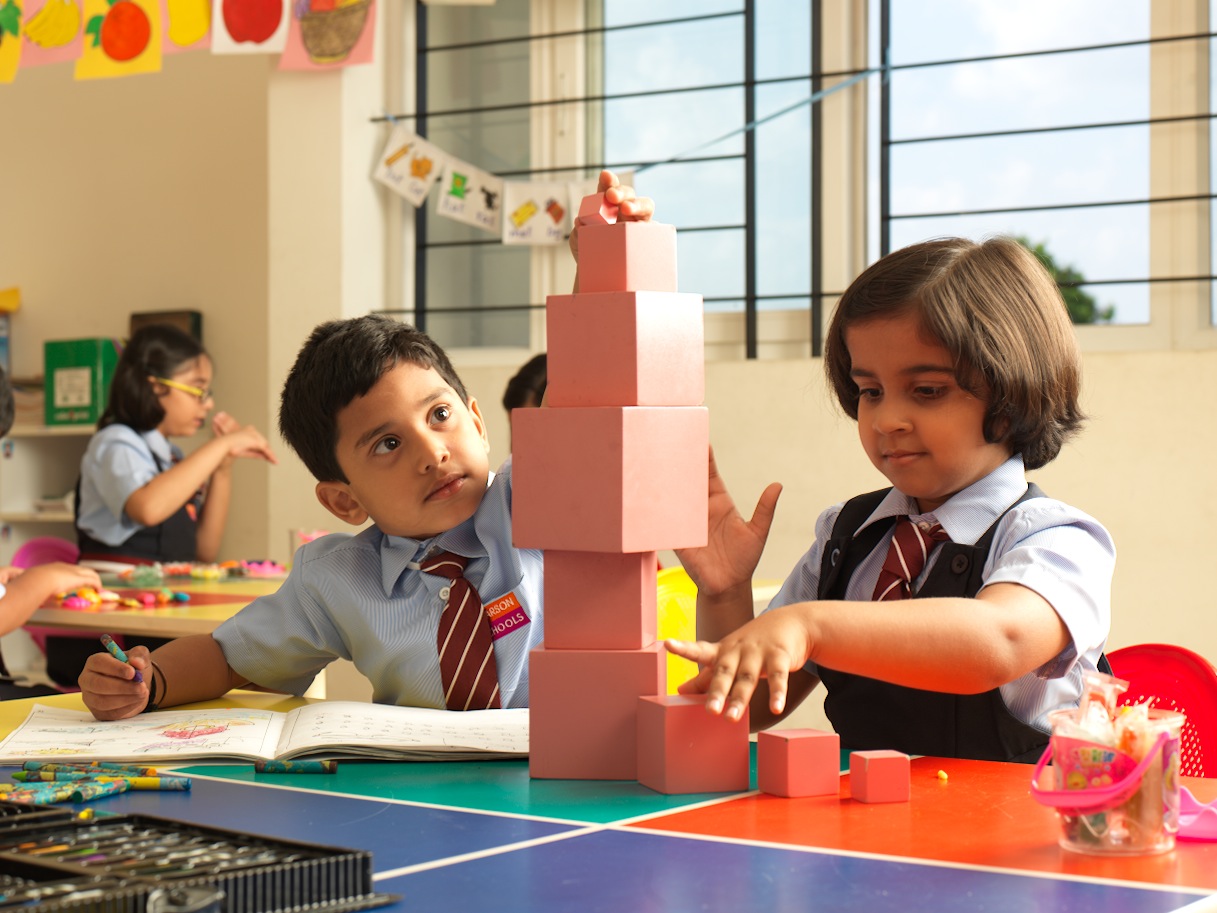
At the Preparatory Stage children learn through stories, discussions, projects, field visits, concrete materials, art, games and local experiences. Language Education focuses on listening, speaking, reading, writing, vocabulary, comprehension, and expression. Children’s literature, storytelling, role play, oral presentations, and creative writing help learners move towards independent reading and confident communication. Mathematics focuses on conceptual understanding, reasoning, problem-solving, procedural fluency, and computational thinking. Learners explore numbers, operations, shapes, measurement, data, patterns, and early algebra through daily-life examples, puzzles, manipulatives, and activities. The World Around Us connects learners with nature, society, environment, local institutions, culture and productive work. It encourages observation, questioning, field visits, surveys, small investigations, and environmental care. Art Education, Physical Education and socio-emotional learning support holistic development. They help children express creatively, stay active, collaborate, regulate emotions, respect diversity, and develop positive learning habits.
The relevance of the Holistic Progress Card becomes clearer when viewed alongside PARAKH Rashtriya Sarvekshan 2024. While the HPC works at the classroom level by documenting each learner’s growth through formative and holistic assessment, PARAKH Rashtriya Sarvekshan works at the system level by generating large-scale evidence on how learners are developing competencies across stages of schooling. It assessed baseline performance in the development of competencies at the end of the Foundational, Preparatory, and Middle Stages through Grades 3, 6, and 9 respectively. Through this survey, PARAKH provides a system-level reflection on the effectiveness of school education. PARAKH Rashtriya Sarvekshan and the Holistic Progress Card therefore serve complementary purposes. Rashtriya Sarvekshan identifies system-level patterns and learning gaps. The HPC helps teachers respond to these gaps at the learner level. The School Quality Assessment and Assurance Framework, developed by PARAKH, complements the Holistic Progress Card by focusing on the larger school ecosystem. While the HPC tracks the progress of individual learners, SQAAF helps schools assess their overall quality across five domains: Administration, Curriculum, Assessment, Infrastructure, and Inclusiveness. It enables schools to identify strengths, recognise gaps and plan improvements through clear benchmarks.
At the Preparatory Stage, the classroom should balance formal learning with movement, exploration and hands-on activities. Children should get opportunities for pair work, group work, individual tasks, discussions, outdoor learning, field visits, and activity-based exploration. The classroom must allow them to observe, question, talk, manipulate materials, and consolidate learning through experience. The NCF-SE also gives importance to proper time organisation. Languages, Mathematics, The World Around Us, Art Education, and Physical Education are given adequate time according to their learning standards.
The Preparatory Stage is a crucial bridge in a child’s educational journey. It consolidates the capacities and dispositions developed in the Foundational Stage and prepares learners for more formal and specialised learning in the Middle Stage. At this stage, children need structured academic support, but they also need play, movement, art, stories, local experiences, hands-on exploration, emotional guidance and social participation. PARAKH’s Holistic Progress Card gives practical shape to the vision of NEP 2020 and NCF-SE. It makes assessment holistic, descriptive, continuous, participatory, and competency-based. PARAKH recognises the child not merely as a test-taker, but as a thinker, speaker, reader, creator, collaborator, problem-solver and sensitive member of society. It brings together teacher observation, self-assessment, peer assessment, parent observation and activity-based evidence. In essence, PARAKH is helping India move from assessment of learning to assessment for learning and assessment as learning. It encourages schools to look beyond marks and recognise the whole child. PARAKH is helping India move towards a more meaningful culture of learning. It reminds that true assessment does not merely record performance; it supports growth, builds confidence and opens pathways for every learner to flourish.
How to Fill the Holistic Progress Card (HPC): Preparatory Stage
Explore More

Secondary Stage Education: Preparing Learners for Choice, Competence and Life
Parakh NCERT
- By Indrani Bhaduri
Building Thinkers: Competency-Based Assessment for the Middle Stage
Parakh NCERT
- By Indrani Bhaduri

Assessment at the Foundational Stage captures not just what children know, but who they are becoming.
Parakh NCERT
- By Indrani Bhaduri
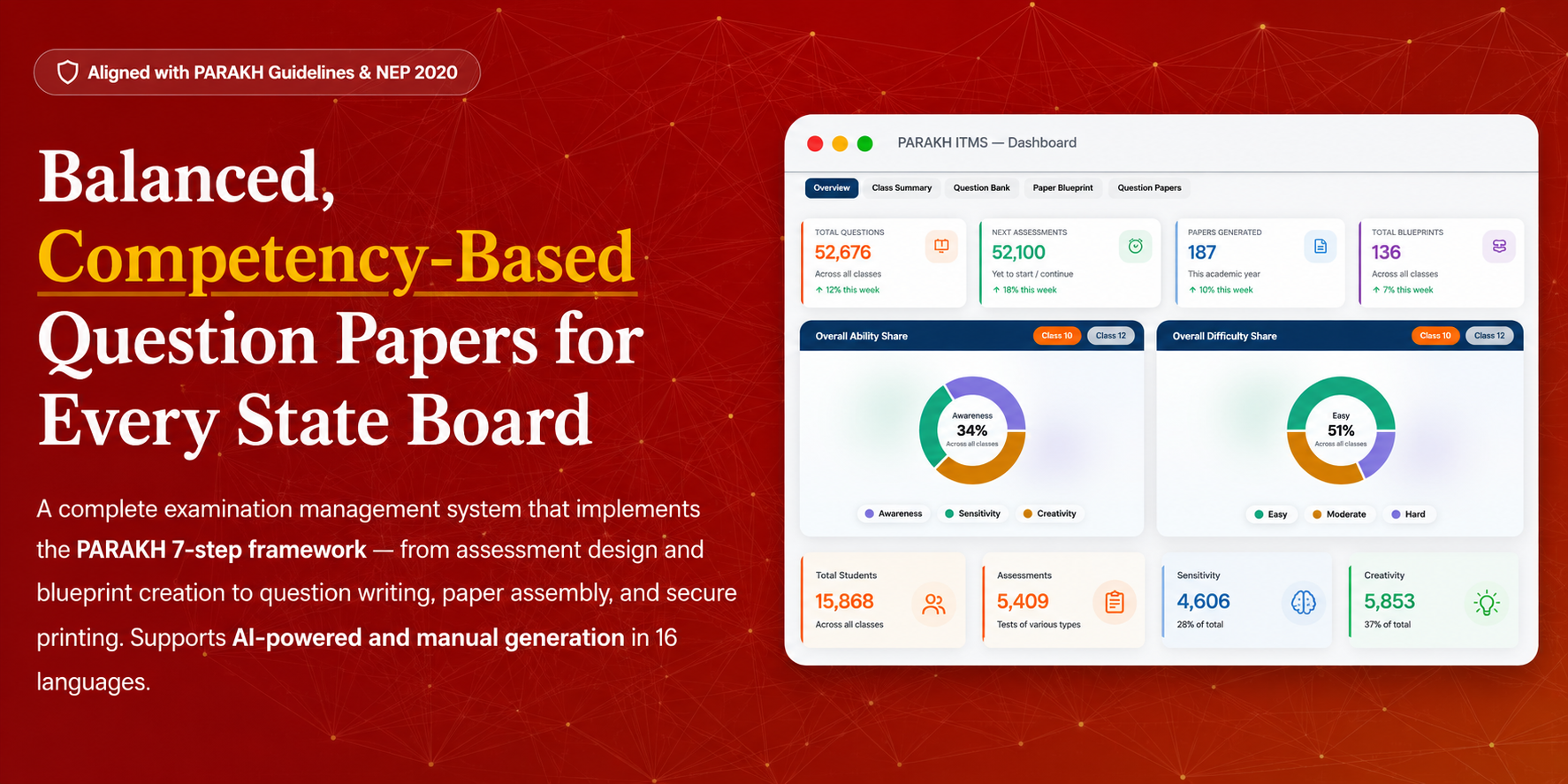
PARAKH ITMS: A Digital Ecosystem for Competency-Based and Multidisciplinary Assessment
Parakh NCERT
- By Indrani Bhaduri