Government of India
 More
More

Our Blogs

Secondary Stage Education: Preparing Learners for Choice, Competence and Life

-
2026-06-24 12:00:00
-
Parakh NCERT
- By Indrani Bhaduri
The Secondary Stage is a crucial phase in school education. It includes students from Grades 9 to 12, usually between the ages of 14 and 18 years. At this stage, learners are no longer only building basic understanding, they are also preparing for higher education, work, citizenship and life. The National Education Policy 2020 and the National Curriculum Framework for School Education 2023 view this stage as a period of flexibility, depth and multidisciplinary learning. The aim is clear. Education at the Secondary Stage should not be limited to marks or board examinations. It should help students understand concepts, develop skills, think critically, make choices and prepare for the future. The NCF recommends that students should not be forced into rigid streams such as Science, Commerce or Humanities. Instead, they should be allowed to choose subjects across different groups. This reflects the NEP 2020 vision of no hard separation between disciplines. A student should be able to combine Science with Art, Mathematics with Vocational Education, or Social Science with Design Thinking. This flexibility helps learners design their own academic and career pathways.
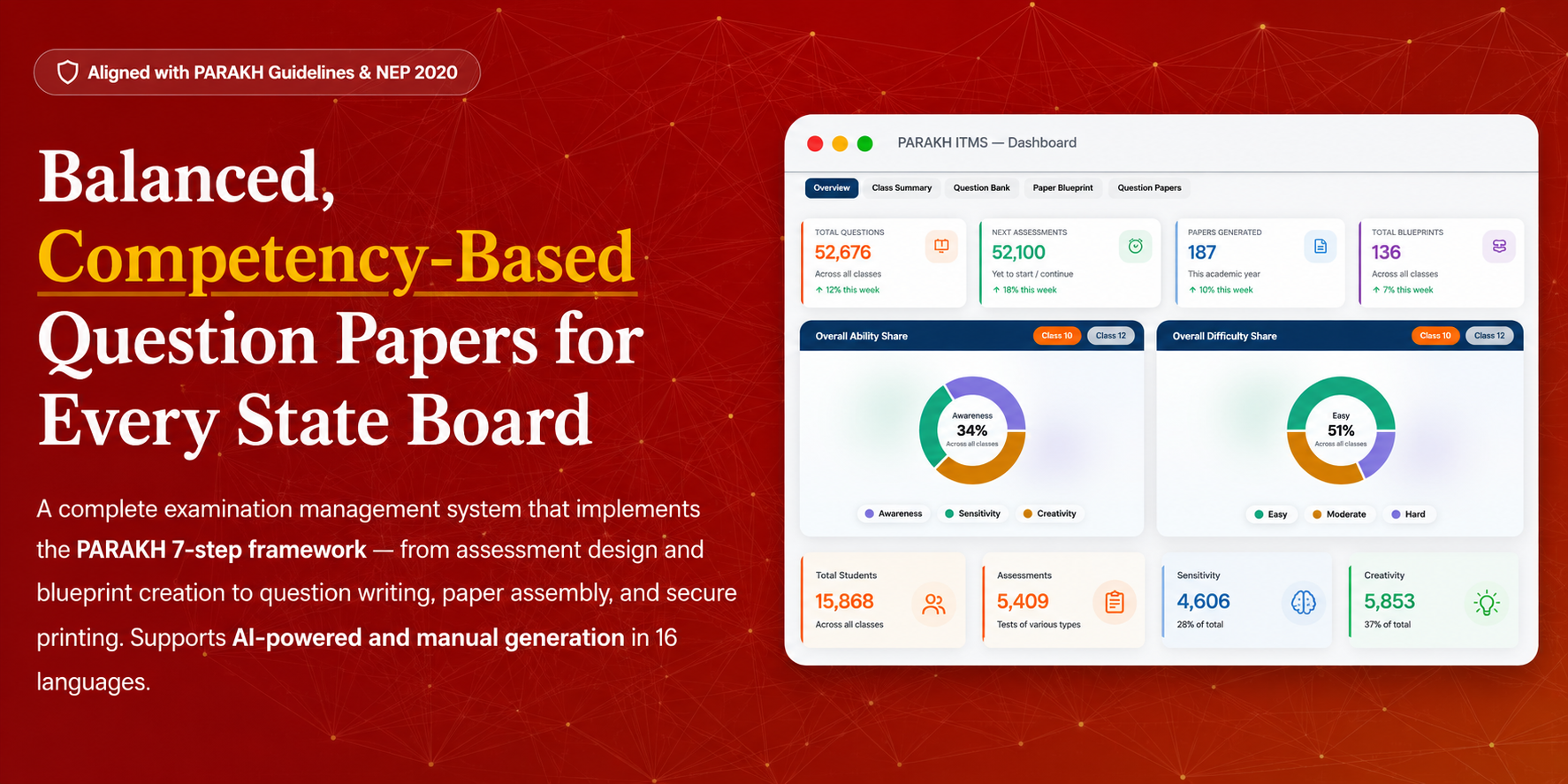
Performance Assessment, Review, and Analysis of Knowledge for Holistic Development (PARAKH ) Integrated Test Management System (ITMS) demonstrates how technology can strengthen assessment processes. PARAKH, through the Holistic Progress Card, supports this vision by making assessment more descriptive, reflective and competency-based.It supports competency-based question development, PARAKH taxonomy-aligned blueprint design, question paper generation, secure printing and end-to-end assessment monitoring. The platform improves efficiency, transparency, consistency, and security. It also supports important assessment reforms such as Two-Level Assessment. The Basic & Proficient level is mandatory for all students. It focuses on conceptual understanding, real-life application, and procedural fluency. Every learner is expected to achieve these foundational competencies. The Advanced level is optional. It is designed for learners who wish to engage with more challenging content. Questions at this level assess multi-concept integration, application in unfamiliar situations, and strategic reasoning. Under this model, all students attempt a standard 100-mark paper comprising Easy 25%,Medium 50% and Difficult 25%. Learners who choose the higher level can also attempt an optional 50-mark Advanced paper. Both levels are based on the same curriculum framework. The model is also linked with the Holistic Progress Card (HPC) (Ministry of Education, 2020, Para. 4.35, p. 18).
The HPC is not just a report card. It is a comprehensive record of learner growth. At the Secondary Stage, the HPC maps student progress through three major abilities: Awareness, Sensitivity and Creativity. Awareness refers to understanding. It includes knowledge of the task, concept, process and context. It also includes attention, engagement and clarity. Sensitivity refers to emotional, social and ethical response. It includes empathy, respect, collaboration, open-mindedness and responsible behaviour. Creativity refers to originality and flexible thinking. It includes curiosity, innovation, problem-solving and the ability to look at situations from different angles. These abilities are assessed across three performance levels: Beginner, Proficient and Advanced. These levels are progressive. They are not meant to label students permanently. They help teachers understand where the learner is and what support is needed next.
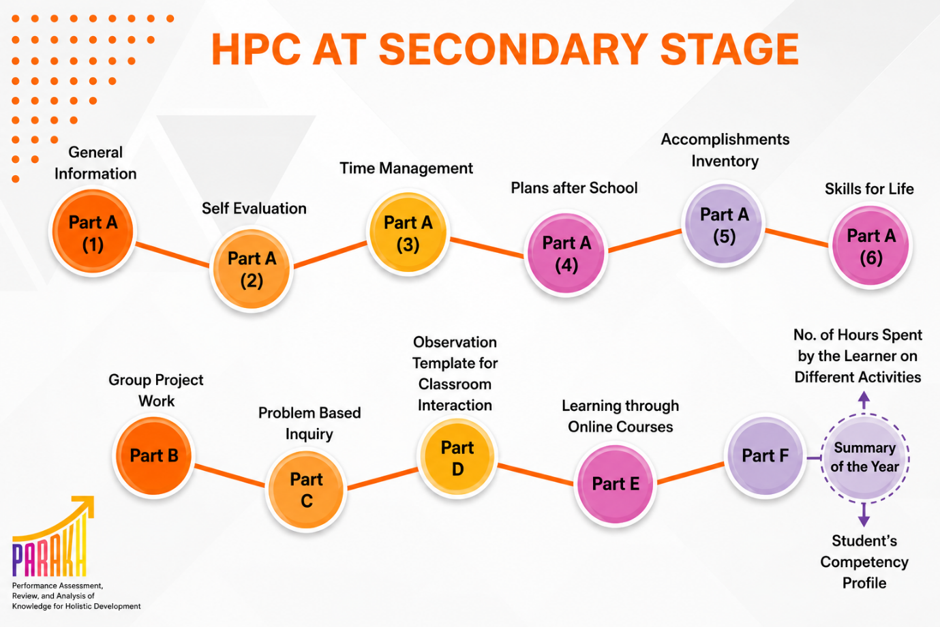
The Secondary Stage HPC is divided into five parts. Part A is mostly filled by the learner. It focuses on general information, self-evaluation, time management, plans after school, accomplishment inventory and skills for life. Students reflect on their learning strategies, strengths, challenges and aspirations. This part helps them break large goals into smaller achievable steps. Part B focuses on group project work. Students work together on real-world tasks or problems. They plan, discuss, create, revise and present a final product. This develops collaboration, responsibility and problem-solving. Part C focuses on problem-based inquiry. Here, students engage with a real-life issue. They may collect data through surveys, interviews or observation. They analyse the issue and present possible solutions. Part D includes classroom interactions. These may include discussions, debates, role plays, simulations, lab work and dramatic presentations. These activities help teachers observe communication, reasoning, participation and confidence. Part E records the time spent by learners on different activities. It also includes a competency profile at the end of the year. This profile gives a broader picture of the learner’s development across important competencies.
At the Secondary Stage, education moves beyond basic understanding. Learners begin to connect knowledge with real-life situations. They also relate their learning to work, technology, and future careers. This is where PARAKH Kaushal Sarvekshan becomes important. Kaushal Sarvekshan is being conducted for grade 3,6 and 9. It can help assess students’ readiness for skill-based learning. It can also examine their preparedness for vocational choices, employability and practical problem-solving.
NEP 2020 (section 4.41), proposed the establishment of PARAKH and one of its crucial mandates is to function as a standard-setting body for “ensuring equivalence of academic standards among learners across all school boards”. PARAKH is working with boards of school education to develop recommendations pertaining to examination reforms. Equivalence of boards means maintaining comparable standards across different educational boards. It ensures fairness in school assessment. Once equivalence is brought across all Boards of India, it will be possible to allocate credit points to all forms of learning, be it academic, vocational, or experiential. Boards should follow similar expectations in curriculum, assessment design, marking schemes, and learning outcomes. The cognitive demand of questions should also be comparable. At present, boards may differ in paper patterns, mark distribution, item difficulty, and evaluation practices.
These differences can affect comparability among students. Therefore, a systematic and transparent framework is needed. It can help ensure that students from different boards are assessed on similar academic standards and competencies. This will promote fairness, credibility, and uniformity in the school assessment system. PARAKH uses Question Paper Templates (QPTs) of Grade X and XII and an Equivalence Questionnaire (EQQ) to study board practices, question types, difficulty level, cognitive demand and assessment design. It has also published reports and guidelines on setting balanced question papers among school boards.
At the Secondary Stage, different forms of assessment should be used. These may include written tests, practical work, projects, open-book assessments, case-based questions, simulations, essays, debates, presentations and classroom discussions. Formative assessment is especially important. It gives regular feedback to students. It helps teachers understand learning gaps. It also allows students to improve their learning strategies. Self-assessment is also valuable at this stage. Students should learn to monitor their own progress. They should reflect on what they are learning. They should also decide how they can improve. Board examinations continue to be important at the Secondary Stage. However, their nature is expected to change. The focus should shift from memorisation to competency. For Grade 10, board examinations should assess competencies linked to curricular goals. For Grade 12, students are expected to pass examinations in languages and selected subjects from different groups. The NCF also recommends that board examinations should become more flexible over time. Modular examinations may be introduced. These would test smaller portions of learning and reduce the pressure of one final examination.
“To further eliminate the ‘high stakes’ aspect of Board Exams, all learners will be allowed to take Board Exams on up to two occasions during any given school year, one main examination and one for improvement, if desired.”(NEP 2020, 4.37)This means that students should not be judged only through one final board examination. NEP 2020 suggests that every learner should get two opportunities in a school year. The first is the main board examination. The second is an improvement examination, which students may take if they want to improve their performance. This reform reduces exam pressure. It gives students a second chance. It also supports flexibility, fairness and student well-being in assessment.
For Classes 9 and 11, assessment is conducted in two terms. In both terms, formative assessment includes portfolio assessment, self-assessment, peer assessment, teacher observation, group work, laboratory work and group discussions. In Term II, project work using materials from the surroundings, paper presentation and Open Text-Based Assessment are also included. Summative assessment is competency-based and conducted through ITMS. Teachers may select content and questions from the question bank.
For Classes 10 and 12, Term I includes formative assessment through portfolio, self-assessment, peer assessment, teacher observation, group work and laboratory work. Summative assessment is competency-based and conducted through ITMS. In Term II, formative assessment includes portfolio, self-assessment, peer assessment, teacher observation, group work, laboratory work, project work, paper presentation with viva voce and group discussions. Summative assessment is based on a question paper containing LA, SA, VSA and MCQ items linked with learning outcomes, following the question paper design and blueprint.
At the Secondary Stage, the balance between formative and summative assessment changes gradually from Class 9 to Class 12. In Class 9, formative assessment carries 70% weightage, while summative assessment carries 30%. In Class 10, both formative and summative assessments are given equal importance, with 50% weightage each. In Class 11, formative assessment carries 40%, while summative assessment increases to 60%. By Class 12, formative assessment carries 30%, and summative assessment carries 70%. This shows a gradual shift from continuous classroom-based assessment to final assessment.
The NCF also recommends that assessments should include higher-order abilities. Students should be assessed on analysis, synthesis, reasoning, creativity and application of knowledge. Questions should be meaningful and challenging. They should help students connect learning with real-life contexts. Through these measures PARAKH has embarked upon a journey of setting norms, standards, guidelines, and implementing activities pertaining to student assessment in its major areas. Over the course of time, a major change in these domains is aspired.
Students at the Secondary Stage are more mature. They are capable of independent thinking. They can handle abstract ideas, complex questions and deeper discussions. Therefore, teaching at this stage should also change. The NCF recommends more opportunities for self-study, exploration, group work, seminars, discussions, projects and inquiry-based learning. Direct instruction still has a role. However, it should be balanced with student participation and reflection. Students should be encouraged to ask questions. They should learn to justify their answers. They should use reasoning, evidence and argumentation. This is especially important in subjects such as Science, Social Science, Mathematics, Environmental Education and interdisciplinary studies.
Classrooms should support discussion and collaboration. Students should get opportunities to present ideas, conduct research, solve problems and work with real-life situations. This helps them become active learners rather than passive receivers of information. Secondary students are also going through emotional, physical and social changes. They may become more self-conscious. They may form strong opinions. They may also seek belonging through peer groups, role models and social identities. Therefore, pedagogy at this stage must be sensitive. Teachers need to create spaces for reflection and dialogue. Students should be encouraged to express their thoughts and emotions in healthy ways. They should learn to listen respectfully, disagree thoughtfully and understand different perspectives.
The NCF also recommends that assessments should include higher-order abilities. Students should be assessed on analysis, synthesis, reasoning, creativity and application of knowledge. Questions should be meaningful and challenging. They should help students connect learning with real-life contexts. Through these measures PARAKH has embarked upon a journey of setting norms, standards, guidelines, and implementing activities pertaining to student assessment in its major areas. Over the course of time, a major change in these domains is aspired.
PARAKH reminds us that assessment is not the end of learning. It is a pathway to understand every learner better. It encourages schools to see children beyond marks and ranks. It values their effort, progress, curiosity and potential. Through the Holistic Progress Card, PARAKH brings a shift from judging learners to supporting them. It makes assessment more thoughtful, more inclusive and more connected to life. It helps students recognise their strengths, work on their challenges and move ahead with confidence. In this sense, PARAKH is not merely an assessment initiative. It is a step towards building reflective learners, sensitive citizens and confident young individuals who are ready for the future.
How to fill HPC at Secondary Level:
Explore More

Building Thinkers: Competency-Based Assessment for the Middle Stage
Parakh NCERT
- By Indrani Bhaduri
From Curiosity to Competency: PARAKH at the Preparatory Stage
Parakh NCERT
- By Indrani Bhaduri

Assessment at the Foundational Stage captures not just what children know, but who they are becoming.
Parakh NCERT
- By Indrani Bhaduri
PARAKH ITMS: A Digital Ecosystem for Competency-Based and Multidisciplinary Assessment
Parakh NCERT
- By Indrani Bhaduri