Government of India
 More
More

Our Blogs

Moving Forward with Purpose: Embedding New Values in Learning and Assessment
-
2026-01-16 12:00:00
-
Parakh NCERT
- By Indrani Bhaduri
Moving Forward with Purpose: Embedding New Values in Learning and Assessment
Because the future doesn’t just need students who can score well.
It needs thinkers, collaborators, and changemakers.
For generations, education has been measured by marks, ranks, and report cards. But in a world shaped by rapid change, artificial intelligence, and global uncertainty, one question is becoming impossible to ignore: Is knowing…enough?
The National Education Policy (NEP) 2020 answers with a resounding no. It invites us to rethink classrooms—not as factories of information, but as spaces where learners grow into thoughtful, capable, creative, and ethical human beings. Learning today is no longer just about what students know, but how they think, feel, and create.
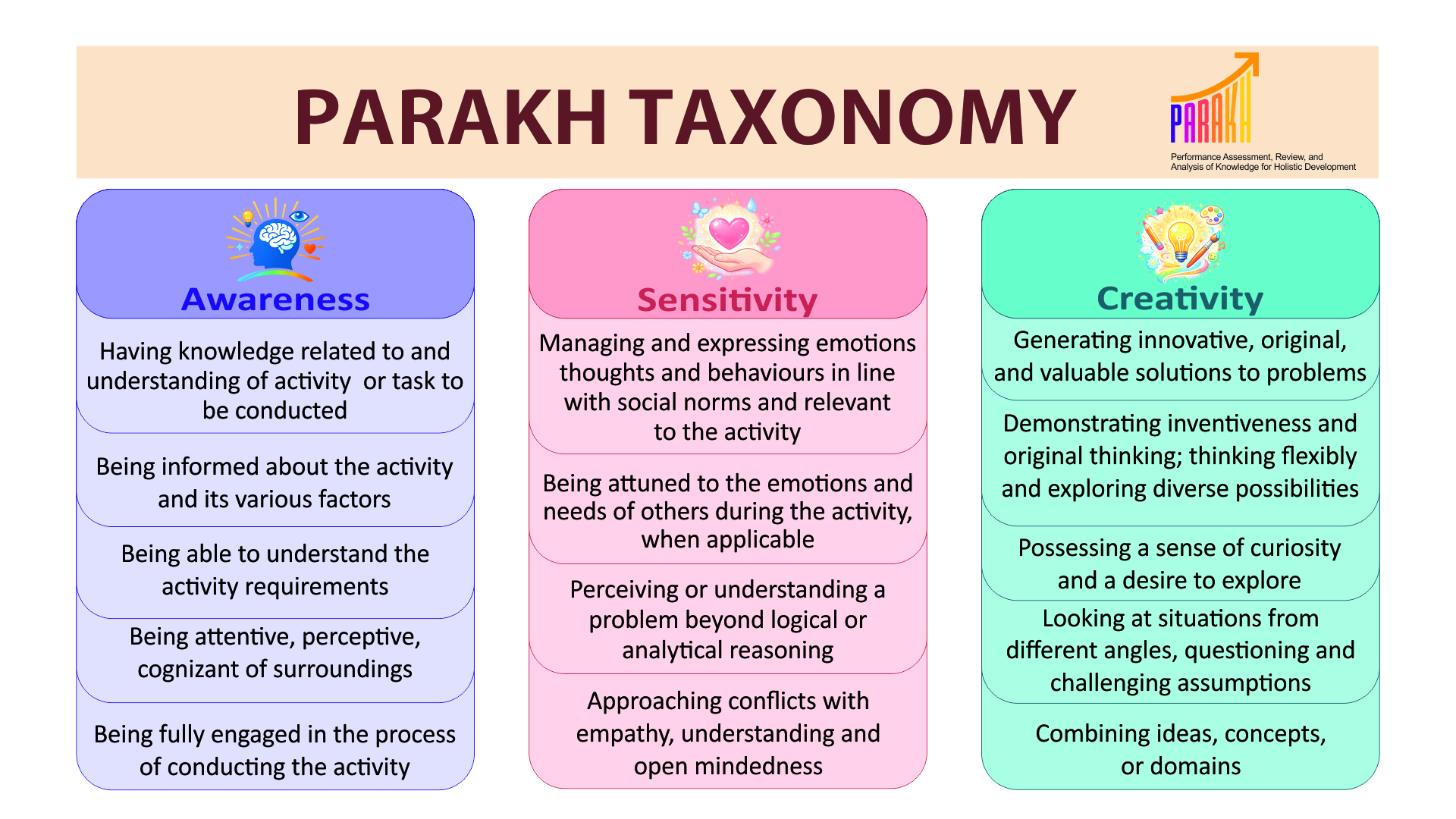
At the heart of this shift lie three powerful, interconnected ideas: Awareness, Sensitivity, and Creativity, that are captured in the new PARAKH Taxonomy. Together, they form the foundation of learning that prepares students not just for exams, but for life.
Aligned with the vision of NEP 2020, the PARAKH Taxonomy offers a comprehensive way to understand and track learners’ growth across three key dimensions through the Holistic Progress Card (HPC). Rooted in the Indian Knowledge System and supported by robust research, the Taxonomy responds to important gaps in existing assessment practices.
Data show that while many State Boards across the country emphasize knowledge-based questions, even sections meant to assess creativity often rely heavily on rote recall. A study conducted by PARAKH on Equivalence Across Educational Boards shows that crucial life skills such as sensitivity and conflict resolution—essential for nurturing a democratic and inclusive society—are rarely given due importance. The PARAKH Taxonomy seeks to address these gaps by offering a balanced roadmap for building an education system that is truly holistic, meaningful, and future-ready.
Building Thinkers
Awareness begins when learning moves beyond memorisation. It’s about helping students understand why something matters, how ideas are connected, and what they can do with what they know.
Instead of asking, “Did you remember…?” OR “Do you understand…?” we now ask, “Can you list three ways of solving this problem?” OR “Can you extract a formula based on these observations?”
This aligns closely with competency-based assessment, where depth of understanding matters more than rote recall. Students reflect on their learning, make connections across subjects, and begin to see purpose in what they study. They analyze and synthesize information to make meaning of the world.
This kind of awareness also nurtures metacognition—learning how to learn. When students understand their own learning processes, they gain confidence, clarity, and ownership of their growth. It’s this journey that the Holistic Progress Card seeks to capture, valuing progress over perfection.
Creating Collaborators
No learner grows in isolation. Classrooms are social spaces, filled with diverse voices, opinions, and experiences. Sensitivity recognises this reality and places human connection at the centre of education.
Students learn to listen, collaborate, disagree respectfully, and work through conflict. Importantly, conflict is no longer something to fear—it becomes a teachable moment. Resolving differences builds empathy, emotional intelligence, and ethical decision-making, all of which are essential life skills.
Rooted deeply in India’s educational philosophy, sensitivity nurtures respect for self and others, responsibility toward the community, and awareness of one’s impact on the world. These are not “soft skills”—they are core competencies, as defined in the NEP 2020, for building inclusive classrooms and compassionate societies.
Preparing Change-makers
If awareness gives students clarity and sensitivity gives them connection, creativity gives them courage to go beyond the pre-defined.
Creativity is not limited to art or expression—it’s the ability to think flexibly, explore possibilities, and apply learning in new and unfamiliar situations. It shows up when students bring pieces of information together to ask better questions, build interconnections across disciplines, and experiment without fear of failure.
Aligned with the PARAKH framework, creativity values originality, exploration, and the ability to see problems from multiple perspectives. In a multidisciplinary system with flexible credit pathways, learners are encouraged to chart their own routes, make meaningful connections, and demonstrate learning in diverse ways.
In short, creativity turns learners from consumers of knowledge into creators of solutions.
Learning That Lasts a Lifetime
When Awareness, Sensitivity, and Creativity come together, education transforms. Classrooms become spaces where students collaborate, reflect, innovate, and grow—not just academically, but as human beings.
By embedding these values within competency-based assessment and flexible credit frameworks, NEP 2020 moves education toward coherence, learner-centricity, and real-world relevance. The goal is clear: to nurture learners who are knowledgeable, empathetic, creative, and confident in navigating complexity.
Explore More
Holistic Progress Cards and Identity Development: From Knowing to Becoming
Parakh NCERT
- By Indrani Bhaduri
More Than a Report Card: The Idea Behind Holistic Progress Cards
Parakh NCERT
- By Indrani Bhaduri
Holistic Progress Cards invite 6th graders to reflect on their ambitions. Is it too early? Not necessarily.
Parakh NCERT
- By Indrani Bhaduri
Balanced Question Papers: Why Assessment Design Matters
Parakh NCERT
- By Indrani Bhaduri