Government of India
 More
More

Our Blogs

Sensitivity
-
2025-12-07 12:00:00
-
PARAKH NCERT
- By Indrani Bhaduri
Sensitivity: The Heartbeat of the PARAKH Taxonomy
Overview
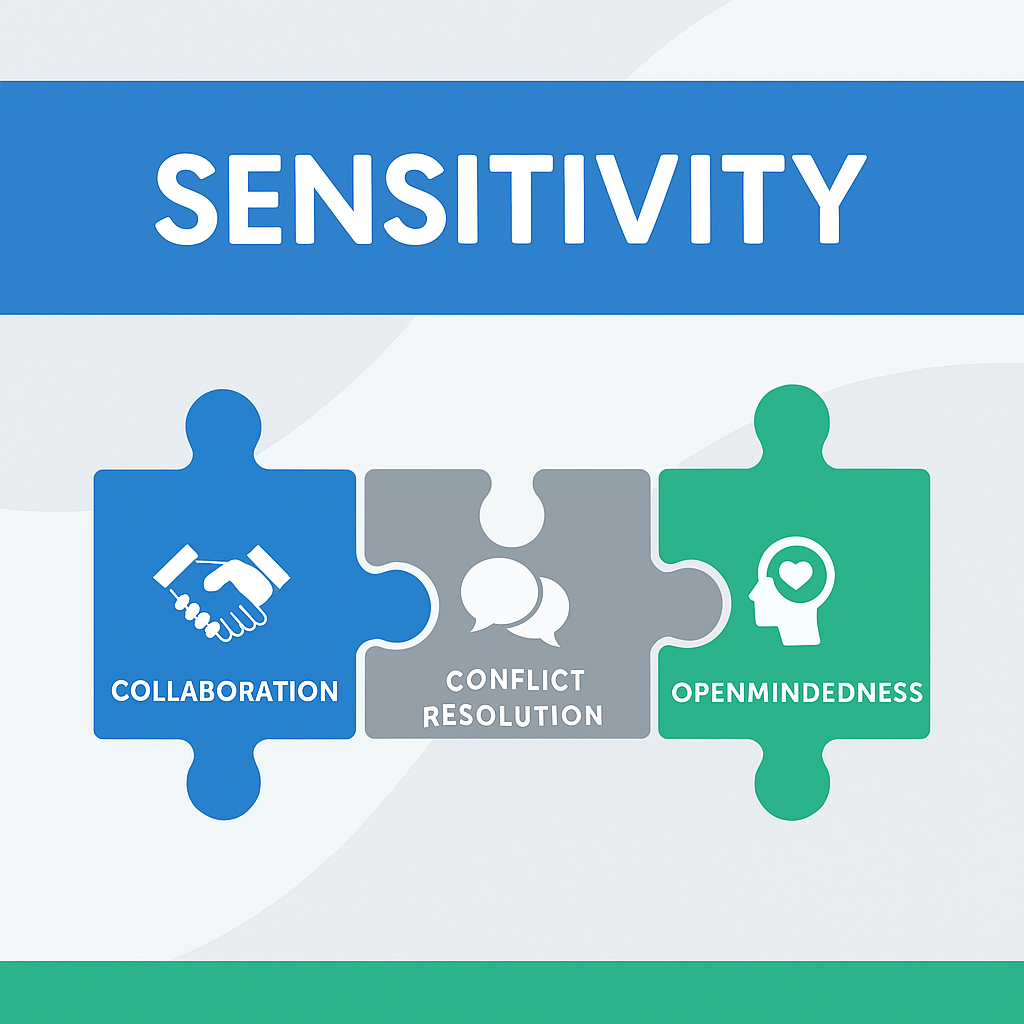
Sensitivity is a foundational domain within the PARAKH Taxonomy that foregrounds the interpersonal and ethical dimensions of learning. It encompasses the dispositions and competencies that enable learners to engage respectfully with others, to manage disagreement constructively, and to remain receptive to diverse perspectives. In contemporary education systems oriented toward competency-based outcomes, Sensitivity complements cognitive and technical proficiencies by preparing learners for collaborative, civic, and professional life.
Sub‑Domains and Their Educational Significance
- Collaboration
Collaboration refers to the capacity to work productively with others toward shared goals. It includes skills such as role negotiation, task coordination, effective communication, mutual accountability, and co‑construction of knowledge. In classroom practice, collaboration supports deeper learning through peer explanation, distributed problem solving, and iterative feedback. Assessment of collaboration should capture both process (e.g., contribution, listening, facilitation) and product (e.g., jointly produced artefacts, collective problem solutions). - Conflict Resolution
Conflict resolution denotes the ability to identify sources of disagreement, manage emotions, apply principled negotiation strategies, and arrive at fair, sustainable outcomes. This sub‑domain cultivates resilience, ethical judgment, and restorative practices. Teaching conflict resolution involves explicit instruction in de‑escalation techniques, interest‑based bargaining, and reflective debriefs that convert disputes into learning opportunities. - Openmindedness
Openmindedness is the disposition to consider alternative viewpoints, to question assumptions, and to revise one’s position in light of evidence or reasoned argument. It underpins critical thinking, intercultural competence, and democratic participation. Pedagogically, openmindedness is fostered through structured debates, perspective‑taking exercises, exposure to diverse sources, and metacognitive reflection on bias and evidence.
The Current Assessment Gap
Despite its centrality to civic and workplace readiness, Sensitivity is frequently underrepresented in summative assessment regimes. Conventional summative instruments prioritize discrete knowledge recall and individual problem solving, producing limited evidence of collaborative behaviour, conflict navigation, or attitudinal openness. This omission creates a misalignment between stated educational goals—such as holistic development and social responsibility—and the signals learners receive about what is valued and rewarded.
Strategies for Integrating Sensitivity into Summative Assessment
- Design authentic, team‑based summative tasks that require coordinated planning, role distribution, and a shared deliverable, with assessment criteria that explicitly evaluate collaborative processes and outcomes.
- Incorporate scenario‑based items that present interpersonal dilemmas; require learners to propose resolution strategies, justify ethical choices, and reflect on stakeholder perspectives.
- Use structured reflective evidence as part of summative portfolios, where learners document their contributions, describe conflict episodes, and analyze how they integrated differing viewpoints.
- Adopt multi‑source evaluation by combining teacher observation, peer assessment, and self‑assessment using standardized rubrics that operationalize indicators for empathy, negotiation, and openness.
- Calibrate rubrics to reliability by defining observable behaviours, providing exemplars, and training assessors to ensure consistency and fairness.
Conclusion
Integrating Sensitivity into summative assessment is both feasible and necessary to align evaluation with the broader aims of education. By making collaboration, conflict resolution, and openmindedness explicit assessment targets, systems can promote learning that is intellectually rigorous and socially responsible. This reorientation affirms that educational success is measured not only by what learners know, but by how they engage with others and contribute to the common good.
Explore More
Aligning Assessment with the Goals of Education
Parakh NCERT
- By Indrani Bhaduri
When Question Papers Reveal More Than Answers: Rethinking Assessment Through PARAKH’s Taxonomy
Parakh NCERT
- By Indrani Bhaduri

Strengthening Curriculum Through Multilingual Evidence
Parakh NCERT
- By Indrani Bhaduri
Rethinking the Foundations of Literacy in FLN
Parakh NCERT
- By Indrani Bhaduri