Government of India
 More
More


Our Blogs

Abhilasha, Pragati and Jagriti :A Roadmap to Educational Excellence
-
2026-06-03 12:00:00
-
Parakh NCERT
- By Indrani Bhaduri
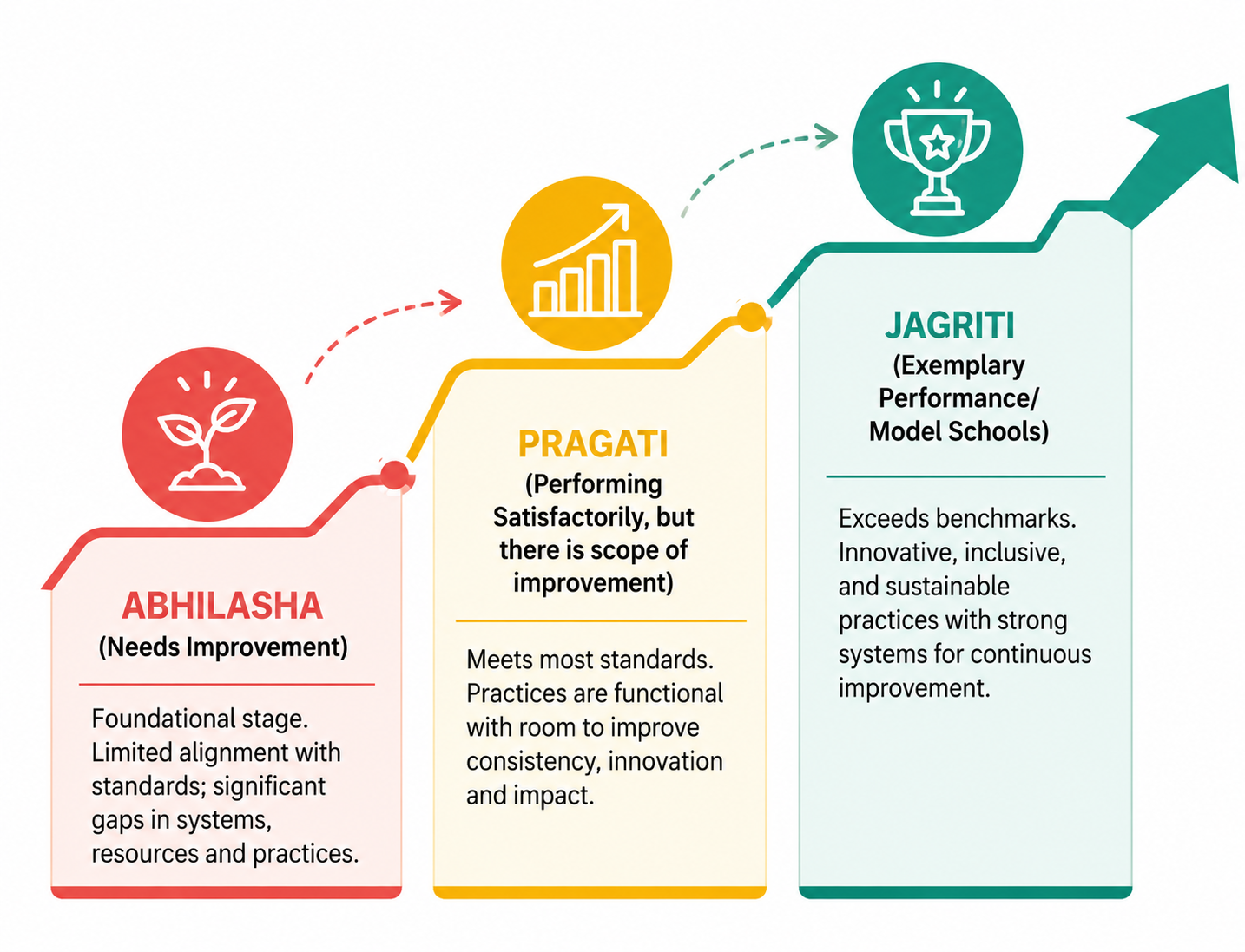
The School Quality Assessment and Assurance Framework (SQAAF) represents a significant step towards strengthening quality and excellence in schools. Developed to address the diverse needs of the education system, SQAAF provides a comprehensive framework for evaluating school performance across five key domains: Administration, Curriculum, Assessment, Infrastructure and Inclusiveness . Schools are provided the flexibility to adopt and implement the framework according to their unique contexts, needs and levels of readiness. The expectation is not immediate perfection but gradual and sustained progress. A distinctive feature of SQAAF is its three-tiered performance level system : Abhilasha, Pragati, and Jagriti. These performance levels are not intended to function as fixed labels. These levels help schools understand their current stage of development, recognize their strengths and identify areas that require improvement. More importantly, they provide a clear pathway for schools to progress towards higher standards of educational quality.
The framework is not intended to function as a regulatory mechanism. Instead, they represent different stages of institutional development. Schools operate in diverse contexts and vary in their levels of preparedness and capacity. Some schools may be working towards establishing basic systems and processes others may have already adopted innovative and learner-centred practices. Recognizing these differences, SQAAF provides a structured framework for self-evaluation. It enables schools to assess their performance against established quality benchmarks. The framework also helps schools identify areas that require attention and plan for further improvement.
The three performance levels are :
1. Abhilasha (Needs Improvement) represents the foundational stage of school quality development. Schools at this level are still working towards meeting the quality benchmarks outlined in SQAAF. They may demonstrate limited alignment with educational standards and inconsistent implementation of quality practices. Challenges may also exist in areas such as infrastructure, learning resources, planning, monitoring, and feedback systems.To move forward, schools should focus on strengthening institutional planning and improving the availability of infrastructure and learning resources. Establishing effective systems for monitoring, evaluation, and feedback is equally important. Attention should also be given to teacher support and professional development. The Abhilasha level should not be viewed as a sign of failure. Rather, it represents the beginning of a school's journey towards continuous improvement and educational excellence.
2. Pragati (Performing Satisfactorily) represents schools that have demonstrated satisfactory performance and have established functional systems and practices. They show a reasonable level of alignment with quality benchmarks and involve stakeholders in the educational process. However, there is still scope for further growth and improvement. Schools at the Pragati level may need to strengthen consistency across different domains of school functioning. Greater attention may also be required to promote inclusiveness, innovation, and the wider adoption of successful practices. To progress further, schools should focus on learner-centred approaches, encourage greater stakeholder participation, and make effective use of data for decision-making. The Pragati level reflects a school that is moving in the right direction and steadily working towards higher standards of quality and excellence.
3.Jagriti (Exemplary Performance ) represents the highest level of achievement within SQAAF. Schools at this level consistently meet or exceed the prescribed quality benchmarks. They demonstrate excellence across all key domains of school functioning. Innovative and learner-centred practices are well integrated into teaching and learning processes. Strong systems for monitoring, evaluation, and continuous improvement are also in place. These schools place a strong emphasis on inclusiveness, sustainability and the holistic development of learners. They actively involve teachers, students, parents, and the wider community in the educational process. The Jagriti level reflects a culture of excellence, collaboration, and continuous growth. As a result, these schools serve as models of good practice and provide inspiration for other institutions striving to enhance educational quality.
As schools progress from Abhilasha to Pragati and eventually to Jagriti, they strengthen their educational practices and improve student learning outcomes. In doing so, they also contribute to the larger vision of creating an equitable, inclusive, and future-ready education system.
Explore More
PARAKH ITMS: A Digital Ecosystem for Competency-Based and Multidisciplinary Assessment
Parakh NCERT
- By Indrani Bhaduri
Rethinking Assessment: How PARAKH is Digitising Every Step
Parakh NCERT
- By Indrani Bhaduri

Holistic Progress Cards and Identity Development: From Knowing to Becoming
Parakh NCERT
- By Indrani Bhaduri
More Than a Report Card: The Idea Behind Holistic Progress Cards
Parakh NCERT
- By Indrani Bhaduri